1. Introduction: The Transformed Food Landscape
Over the last half-century, the global food system has undergone a foundational, unprecedented shift. For millennia, human food processing was primarily limited to mechanical and chemical stabilization methods designed to extend the shelf life of whole ingredients or make them digestible—such as drying, salting, smoking, milling, and fermenting. Today, however, the modern supermarket is filled with highly engineered, industrial products that bare little to no biological resemblance to the crops and animals from which they were derived. These items are broadly classified as Ultra-Processed Foods (UPFs).
In modern industrial nations like the United States and the United Kingdom, recent dietary assessments indicate that UPFs now account for an astonishing 60% of total daily calorie intake among adults, and nearly 70% among children and adolescents. What was once a temporary convenience or an occasional indulgence has effectively replaced whole foods and traditional culinary preparations as the baseline foundation of the modern human diet. This seismic dietary shift has directly coincided with a catastrophic rise in worldwide obesity, metabolic syndrome, type 2 diabetes, and related non-communicable diseases (NCDs).
2. Defining Ultra-Processed Foods: Why Are They Called "Ultra-Processed"?
The term "ultra-processed food" is not merely a generic descriptor for junk food; it is a scientifically codified category derived from industrial manufacturing methodologies. To understand why a food is designated as ultra-processed, one must examine the specific chemical, physical, and technological sequences involved in its assembly.
Unlike standard processing, which adds simple culinary ingredients like salt, sugar, or oil to a recognizable whole food (such as canning fresh green beans or baking artisan bread), ultra-processing breaks whole foods down into their foundational industrial constituents. Through advanced manufacturing techniques, commodities such as corn, soy, wheat, sugar cane, and factory-farmed animal carcasses are chemically or mechanically deconstructed into pure starches, isolated sugars, refined proteins, hydrogenated fats, and chemically modified fibers.
Once these cheap, highly stable raw substrates are isolated, they are reassembled into commercial products using a highly sophisticated cocktail of cosmetic industrial additives. These additives include emulsifiers, thickeners, bulking agents, gelling agents, artificial colors, synthetic flavor enhancers, non-nutritive sweeteners, and anti-foaming agents. The primary goal of this formulation sequence is to create products that are exceptionally cheap to manufacture, highly shelf-stable for long-distance logistics, hyper-palatable to stimulate overconsumption, and immensely profitable for multinational corporations. A product is almost certainly ultra-processed if its commercial ingredients list contains substances that are never or rarely found in a standard home kitchen—such as high-fructose corn syrup, hydrogenated or transesterified oils, hydrolyzed plant proteins, maltodextrin, carboxymethylcellulose, or polysorbate-80.
3. The "Hidden" Ultra-Processed Foods in Your Kitchen
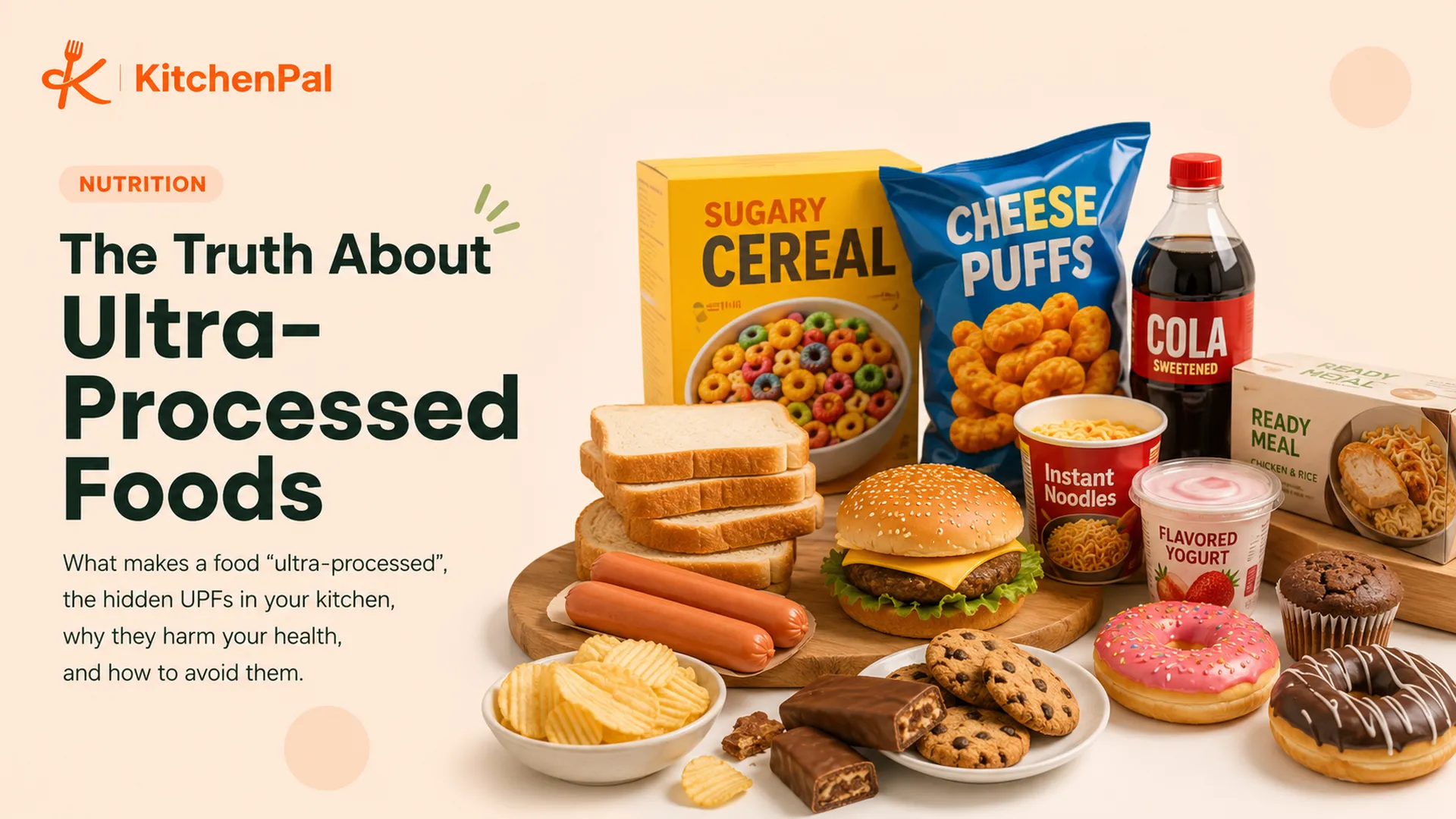
While consumers widely recognize that carbonated soft drinks, frozen pizzas, instant noodles, candies, and commercial potato chips are heavily processed, the true danger of UPFs often lies in items that masquerade under a "health halo." These are everyday products engineered to look natural, wholesome, and nutritious, but are fundamentally industrial reassemblies.
Commercial Supermarket Sliced Bread: Traditional bread requires only four ingredients: flour, water, yeast, and salt. Conversely, a typical loaf of mass-market supermarket white or whole-wheat bread contains upwards of twenty ingredients. These frequently include emulsifiers like DATEM (mono- and diacetyltartaric acid esters of mono- and diglycerides of fatty acids), calcium propionate (a preservative), dough conditioners (such as azodicarbonamide), soy lecithin, and added sugars or high-fructose corn syrup to keep the bread improbably soft for weeks on end.
Plant-Based Milk Alternatives (Oat, Soy, Almond): While home-prepared oat milk is simply water combined with strained oats, commercial shelf-stable alternative milks are often industrial emulsions. They are regularly formulated with added industrial sugars, dipotassium phosphate (a stabilizer to prevent curdling in coffee), synthetic vitamin slurries, and thickeners or gelling agents like gellan gum or carrageenan to artificially mimic the smooth mouthfeel of whole dairy cream.
Flavored Low-Fat Yogurts and Fruit Mousses: When fat is mechanically skimmed from dairy products, the resulting food loses its structural richness and flavor appeal. To remedy this, manufacturers heavily compensate by adding thickeners like modified maize starch, pork gelatin, acidity regulators, artificial colors, and massive doses of fructose-glucose syrups or non-nutritive sweeteners. A single 150g tub of commercial low-fat fruit yogurt can often contain more added sugars than a standard pastry.
Commercial Breakfast Cereals and Health Granola Bars: Frequently marketed as excellent sources of dietary fiber and essential vitamins, these products are typically manufactured via a high-temperature, high-pressure industrial process known as extrusion. This process destroys the native structural matrix of grains. The resulting shapes are coated in heavy sugar syrups, maltodextrin, hydrogenated fats, synthetic flavorings, and chemical preservatives to guarantee a crunch that lasts for months inside a cardboard box.
4. Pathophysiology: Why UPFs Are Actively Destructive to Human Health
The biological hazard of ultra-processed foods extends far beyond their high concentrations of salt, added sugars, and saturated fats. While their poor nutrient profile is undeniably harmful, the physical transformation of the food matrix and the presence of cosmetic chemical additives trigger specific, deeply damaging physiological responses in the human body.
The Elimination of the Natural Food Matrix
In nature, nutrients are encapsulated within a complex cellular structure of fibers, proteins, and minerals known as the food matrix. This physical structure forces the human digestive system to work to break down the food, leading to a slow, controlled release of macronutrients into the bloodstream. Ultra-processing completely obliterates this biological matrix. Because the ingredients are pre-digested, powdered, and reassembled, UPFs are absorbed with extreme rapidity by the upper gastrointestinal tract.
This structural absence leads to profound postprandial metabolic disruptions, most notably a severe spike in blood glucose followed by an aggressive surge in insulin secretion. Approximately two to four hours after consuming these heavily processed, refined carbohydrates, individuals frequently experience an acute "glucose dip" where blood sugar drops below baseline levels. This rapid drop triggers systemic fatigue, headaches, irritability, and a powerful biological signal to consume more fast-acting carbohydrates, locking the individual into an ongoing cycle of overeating.

Hyper-Palatability and Cognitive Overrides
UPFs are engineered by industrial food scientists to hit the precise "bliss point"—an exact, scientifically optimized combination of fats, sugars, and salts that does not occur in whole foods. This sensory profile bypasses our natural internal satiety mechanisms. When eating whole foods, stretch receptors in the stomach and hormones like leptin and peptide YY signal to the brain's hypothalamus that nutritional needs have been met. The hyper-palatability of UPFs overrides these biological feedback loops by flooding the brain's reward centers with dopamine, mimicking the neural pathways activated by addictive substances. This encourages passive overconsumption; individuals regularly finish a family-sized package of chips or cookies without ever experiencing an explicit sensation of fullness.
The Disruption of the Gut Microbiome and Epidemiological Evidence
The human gastrointestinal tract is home to trillions of microorganisms that play a critical role in metabolic regulation, immune system functionality, and cognitive health. This microbiome relies heavily on a diverse intake of intact prebiotic fibers and polyphenols found in whole plants. Because UPFs are largely stripped of fiber and loaded with synthetic chemicals, they effectively starve beneficial gut microbes. Furthermore, ubiquitous industrial additives like emulsifiers (carboxymethylcellulose, polysorbate-80, and DATEM) act like chemical detergents within the gut. Medical studies indicate that these compounds actively break down the protective mucous layer lining the intestinal wall. This allows opportunistic bacteria to come into direct contact with the intestinal epithelium, inducing chronic low-grade gut inflammation, increasing intestinal permeability (often termed "leaky gut"), and driving systemic insulin resistance.
The long-term public health consequences of high UPF consumption have been thoroughly documented in massive, rigorous epidemiological cohorts and controlled clinical trials:
- The NIH Controlled Feeding Trial (Dr. Kevin Hall, 2019): In a landmark randomized controlled metabolic ward study, 20 healthy adults were provided with either an ultra-processed or an unprocessed diet for two weeks each. The meals were precisely matched for total calories, carbohydrates, fat, protein, sodium, and fiber. Despite the diets being nutritionally identical on paper, participants on the ultra-processed diet voluntarily consumed an average of 508 additional calories per day and gained an average of 0.9 kilograms (2 pounds) in just 14 days, providing definitive proof that the degree of processing itself drives overeating.
- The NutriNet-Santé Cohort Study (France): Following over 100,000 adults for multiple years, researchers discovered that every 10% increase in the proportion of ultra-processed foods in the diet was independently associated with a 12% higher risk of cardiovascular disease, a 13% higher risk of coronary heart disease, and an 11% higher risk of cerebrovascular accidents (strokes).
- All-Cause Mortality Correlations: Comprehensive multi-decade studies published in prominent medical journals, including The BMJ and The Lancet, have consistently shown that individuals in the highest quartile of UPF intake experience a 20% to 25% increase in all-cause mortality. High intake is explicitly tied to an increased risk of developing 32 distinct chronic health conditions, including type 2 diabetes, severe anxiety, clinical depression, non-alcoholic fatty liver disease, and colorectal cancers.
5. So What Can You Do As A Consumer To Avoid UPFs?
Avoiding ultra-processed foods (UPFs) comes down to prioritizing whole, single-ingredient foods and utilizing the perimeter of the grocery store. Key strategies include reading ingredient lists to spot industrial additives and preparing simple meals at home.
Here is how you can systematically reduce UPFs in your diet:
- Shop the Store Perimeter: Focus on the outer aisles of the supermarket where fresh produce, unprocessed meats, fish, eggs, and bulk grains are typically located.
- Read Ingredient Lists: A general rule is to avoid products with more than 5 ingredients or those containing unrecognizable chemical additives, high-fructose syrup, maltodextrin, or hydrogenated oils.
-
Make Simple Swaps:
- Instead of store-bought dressings, make your own olive-oil-and-vinegar bases.
- Instead of pre-shredded cheese (which contains anti-caking agents), buy blocks and shred them yourself.
- Instead of flavored, sweetened yogurts, buy plain Greek yogurt and flavor it with fresh fruit.
- Recreate Favorites at Home: Cook from scratch as much as possible. For example, make quick pasta sauces using plain canned tomatoes instead of jarred sauces laden with hidden sugars and salt.
- Cook and Prep in Batches: Keep healthy, easily accessible whole foods on hand, such as raw nuts, fresh fruit, hard-boiled eggs, and chopped veggies.
Use KitchenPal's barcode scanner to check what's already in your pantry before you shop, and lean on the Recipes by Ingredient engine to turn whole, unprocessed staples you already own into a meal—no jarred sauces or pre-packaged shortcuts required.